Something fundamental has changed in how businesses defend themselves against cyber threats. For decades, the Security Operations Centre has relied on the same model: banks of screens, teams of human analysts working in shifts, manually sifting through thousands of alerts to find the handful that represent genuine danger. That model was never accessible to small businesses — the cost alone made it impossible. But even for enterprises that could afford it, the model is breaking down. Alert volumes are overwhelming. Skilled analysts are impossible to recruit and harder to retain. Attackers move faster than humans can respond.
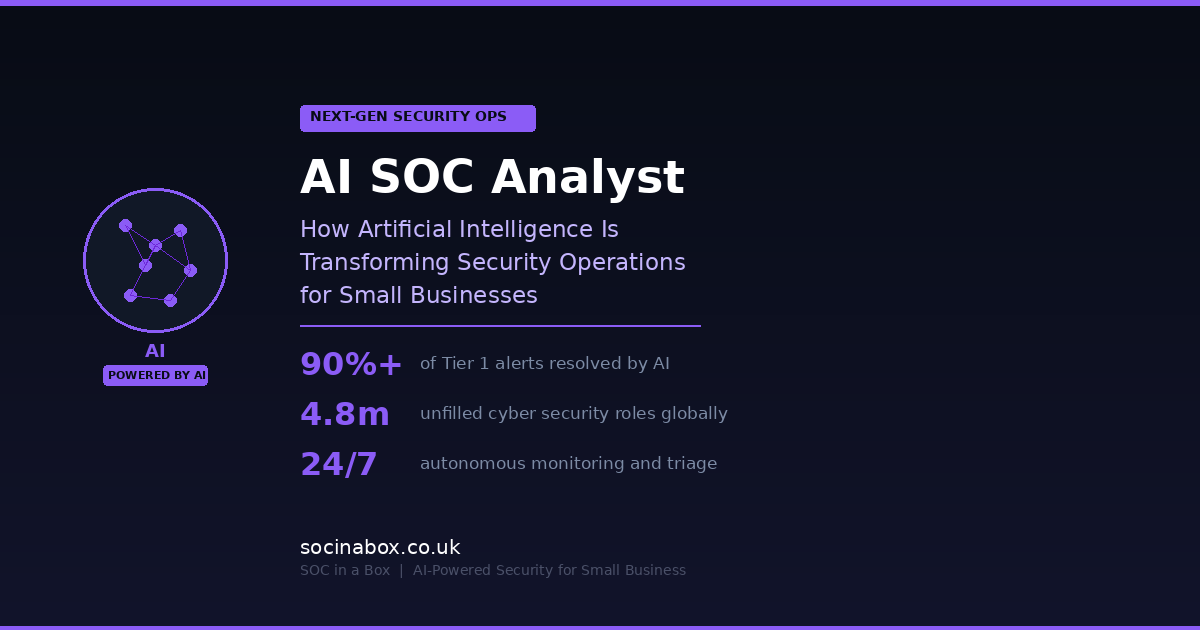
Enter the AI SOC analyst — an autonomous, AI-powered system that triages, investigates, and responds to security alerts around the clock, without requiring a room full of staff or a seven-figure annual budget. For small businesses, this technology represents a genuine step change: enterprise-grade security operations that were previously out of reach are now becoming affordable, practical, and effective at any scale.
This article explains what an AI SOC analyst actually is, how the technology works, why it matters more in 2026 than ever before, and what it means specifically for small businesses trying to protect themselves in an increasingly hostile threat landscape. If you are new to the concept of a Security Operations Centre entirely, our guide to what a SOC is and why your business needs one provides the foundational context.
What Is an AI SOC Analyst?
An AI SOC analyst is an autonomous software system, typically powered by large language models and purpose-built AI agents, that replicates the work traditionally performed by human Tier 1 security analysts. In a conventional SOC, Tier 1 analysts are the front line — they receive alerts from security tools, investigate whether each alert represents a genuine threat, and either resolve it or escalate it to more senior analysts for deeper investigation. It is essential, repetitive, high-volume work that demands constant attention.
An AI SOC analyst performs the same function, but at machine speed and machine scale. It ingests alerts from across your security stack — your SIEM, EDR, email security, cloud platforms, firewalls, identity providers — and investigates each one autonomously. It queries your tools, correlates data from multiple sources, tests hypotheses about what might be happening, reaches a verdict on whether the alert is benign or malicious, and either resolves it or escalates it with a complete investigation report for a human analyst to review.
The critical difference from older automation approaches — such as SOAR platforms with static playbooks — is that an AI SOC analyst does not follow a pre-written script. It reasons. It plans its investigation dynamically based on the specific alert and the available evidence. If its first line of enquiry does not yield a clear answer, it adapts and tries a different approach, just as a skilled human analyst would. This is what the industry calls agentic AI: autonomous agents that can plan, execute, and adapt without human intervention at each step.
The result is that every alert gets investigated — not just the ones that a human analyst happens to have time for. In a traditional SOC, the reality is that the vast majority of alerts are never properly investigated because the volume overwhelms the team. Industry data consistently shows that SOC teams are drowning in upwards of 100,000 daily alerts, with only 1–5% being genuine threats. The other 95–99% are false positives or low-priority noise, but each one still needs to be looked at to make that determination. An AI SOC analyst handles that entire volume, consistently and without fatigue, ensuring that the genuine threats hidden in the noise are never missed.
Why the AI SOC Analyst Has Emerged Now
AI has been used in cyber security for years — machine learning models have long underpinned anomaly detection, malware classification, and behavioural analysis. What has changed in 2025 and 2026 is the emergence of agentic AI: systems that do not just detect anomalies but actively investigate, reason through evidence, and take action. Several converging forces have made this the moment when the AI SOC analyst has moved from concept to production reality.
The Skills Crisis Has Reached Breaking Point
The global cyber security workforce gap now stands at approximately 4.8 million unfilled positions. In the United Kingdom, an estimated 637,000 businesses lack the basic skills needed to implement effective cyber security measures. The 2026 SANS Cybersecurity Workforce Report found that skills gaps have decisively overtaken headcount shortages as the industry's top workforce challenge, with 60% of organisations identifying skills deficits as a greater problem than staffing levels.
For small businesses, the situation is even more acute. Recruiting a single SOC analyst in the UK requires a salary of £40,000 to £65,000, and even then, the average tenure is under two years before they move to a higher-paying role. Building genuine 24/7 coverage with human analysts requires four to five full-time staff, pushing costs to £200,000 to £350,000 per year — before you add the tools they need to do their job. For businesses with 10, 50, or even 200 employees, that is simply not a realistic investment. Our savings calculator shows exactly how the numbers compare for your specific business size.
The AI SOC analyst changes this equation fundamentally. A single AI system can handle unlimited alerts around the clock, delivering investigative capacity that would require a team of five to ten human analysts to replicate, at a fraction of the cost.
Alert Volumes Have Overwhelmed Human Capacity
The proliferation of security tools — EDR, SIEM, cloud security, email filtering, identity monitoring, DLP — has been a net positive for visibility, but it has created an alert volume problem that human teams simply cannot solve. Every tool generates alerts. Most of those alerts are false positives. But every alert must be investigated because the one you ignore might be the one that matters.
In traditional SOCs, this leads to alert fatigue: analysts become overwhelmed, start making shortcuts, and inevitably miss genuine threats buried in the noise. The SANS 2026 report found that 27% of organisations have experienced breaches directly attributable to workforce capability gaps — gaps that manifest most acutely in the inability to investigate and respond to alerts quickly enough. An AI SOC analyst is immune to fatigue, investigates every alert with the same thoroughness whether it is the first alert of the day or the ten-thousandth, and delivers its verdicts in minutes rather than hours.
Attackers Have Already Adopted AI
The threat landscape itself has shifted. Attackers now use AI to automate the entire attack lifecycle — from crafting personalised phishing emails that bypass traditional filters, to scanning for vulnerabilities across thousands of targets simultaneously, to deploying polymorphic malware that changes its signature to evade detection. The commercialisation of Ransomware-as-a-Service, combined with AI-generated attack tools, has made it profitable for criminals to target businesses that were previously too small to be worth the manual effort. Our ransomware guide for small UK businesses explains how these attacks specifically target SMBs and what a real attack looks like in practice.
If attackers are using AI to scale their offence, defenders must use AI to scale their defence. A manual SOC operating at human speed simply cannot keep pace with AI-powered attacks. The AI SOC analyst levels the playing field by matching machine speed with machine speed.
How an AI SOC Analyst Actually Works
Understanding the technology behind an AI SOC analyst helps demystify what can feel like an abstract concept. Here is a step-by-step walkthrough of what happens when an alert fires in an AI-powered SOC.
Step 1: Alert Ingestion
The AI system connects to your existing security tools via API integrations — your SIEM, EDR platform, email security gateway, cloud security tools, identity provider, firewall, and any other source of security telemetry. When any of these tools generates an alert, it is immediately ingested by the AI SOC analyst for investigation. There is no queue, no triage delay, no waiting for a human analyst to pick it up.
Step 2: Autonomous Investigation
This is where the agentic AI capability distinguishes an AI SOC analyst from older automation. Rather than following a pre-written playbook, the AI dynamically plans its investigation based on the alert type, the data available, and the context of your environment. It might query your EDR for process execution history on the affected endpoint, check your identity provider for unusual login patterns from the associated user account, search your SIEM for correlated events across other systems, examine your email gateway for related phishing activity, and cross-reference against threat intelligence feeds for known indicators of compromise.
Crucially, the AI adapts as it goes. If the initial evidence is inconclusive, it adjusts its approach — querying additional tools, broadening or narrowing its scope, testing alternative hypotheses. This recursive reasoning is what makes agentic AI fundamentally different from rule-based automation.
To see how this works in a real production environment, our article on EmilyAI — the triage layer that lets human analysts focus on real threats explains how our own AI engine, eight years in production, pre-processes every alert, eliminates 92% of noise, and enriches context before a human analyst ever sees it.
Step 3: Evidence Correlation and Verdict
The AI synthesises evidence from across all the tools it has queried, correlates signals that a human analyst might take hours to connect, and reaches a verdict: benign, suspicious, or malicious. Every step of its reasoning is documented and transparent — you can see exactly which tools were queried, what data was returned, and why the AI reached its conclusion. This explainability is essential for trust, auditability, and regulatory compliance.
Step 4: Resolution or Escalation
For alerts determined to be benign — the vast majority — the AI resolves them automatically with a full investigation report. For alerts identified as genuinely malicious or requiring human judgment, the AI escalates with a complete analysis: what happened, which systems are affected, the probable root cause, and recommended response actions. Human analysts receive a finished investigation, not a raw alert — transforming their role from data janitor to strategic decision-maker.
Step 5: Automated Response (Where Configured)
Depending on the platform and the organisation's risk appetite, the AI SOC analyst can also execute containment actions automatically — isolating compromised endpoints, blocking malicious IP addresses, disabling compromised user accounts, or quarantining suspicious emails. This drastically reduces the time between detection and containment, which is often the difference between a contained incident and a full-blown breach.
What an AI SOC Analyst Means for Small Businesses
For large enterprises, the AI SOC analyst is a force multiplier that allows existing SOC teams to handle exponentially more alerts. For small businesses, it is something more transformative: it makes real security operations possible for the first time.
Enterprise-Grade Protection at SMB Prices
The traditional security operations model required deep pockets: millions in tooling, hundreds of thousands in analyst salaries, and the organisational maturity to manage it all. An AI SOC analyst collapses those costs dramatically. Managed services built on AI SOC technology can deliver 24/7 monitoring, investigation, and response for a fraction of what a single human analyst would cost — bringing genuine SOC capability within reach of businesses with 10, 20, or 50 employees.
Our own SOC in a Box platform is built on this principle: using AI-powered analysis through the SOC365 detection engine and EmilyAI triage layer to deliver continuous security monitoring to small businesses at a price point that makes sense for their size. It is the same detection, investigation, and response capability that enterprises pay millions for, delivered through a managed service model that does not require you to hire a single security specialist.
No More Alert Fatigue
If you currently rely on a managed IT provider or a small internal team for security, you know the problem: alerts pile up, logs go unreviewed, and the sheer volume of noise means genuine threats get lost. An AI SOC analyst eliminates this entirely. Every alert is investigated, every time, with consistent thoroughness. The system does not get tired on a Friday afternoon, does not take holidays, and does not prioritise the alerts that are easiest to close over the ones that actually matter.
Faster Response Times
Speed matters enormously in cyber security. The average time for an attacker to move laterally through a network after initial compromise is measured in hours, not days. A traditional SOC relying on human triage might take hours to get to an alert, hours more to investigate it, and further time to coordinate a response. An AI SOC analyst completes a full investigation in minutes — often under ten minutes from alert to verdict. That speed advantage can mean the difference between a contained incident and a catastrophic breach. Our article on what a data breach actually costs a small UK business puts hard numbers on why those minutes matter so much.
Bridging the Skills Gap
Small businesses cannot compete with enterprises for cyber security talent. The AI SOC analyst does not eliminate the need for human expertise — you still need people to make strategic decisions, handle complex incidents, and provide business context that AI cannot understand. But it dramatically reduces the volume of work that requires human attention, allowing a small team (or a managed service provider) to deliver effective security without needing a platoon of Tier 1 analysts.
Working Alongside Cyber Essentials
For UK small businesses, Cyber Essentials Certification provides the baseline preventive controls that every organisation should have in place. An AI SOC analyst adds the detection and response layer that Cyber Essentials does not cover. Certification locks the doors and windows. The AI SOC analyst watches for the threats that find a way through despite those controls. Together, they provide a proportionate, layered defence that covers both prevention and detection — exactly the approach recommended by the NCSC's Small Business Guide.
AI SOC Analyst vs Traditional SOC vs No SOC
To make the comparison concrete, here is how the three approaches stack up for a typical UK small business with 50 employees.
No SOC (most small businesses today): You rely on endpoint antivirus, a firewall, and hope. Alerts from your security tools go unmonitored outside business hours — and often during business hours too, because no one has time to review them. Threats are detected only when they cause visible damage: a ransomware screen, an email compromise discovered by a customer, or a regulator informing you of a data breach. Average detection time is measured in weeks or months. Cost is low upfront but the risk exposure is enormous.
Traditional human SOC: Requires four to five full-time analysts for 24/7 coverage, at a total staffing cost of £200,000 to £350,000 per year, plus £50,000 to £150,000 in tooling (SIEM licences, EDR, threat intelligence feeds). Average alert investigation time is 30 to 60 minutes per alert. Human analysts investigate perhaps 20–40 alerts per shift, meaning the vast majority go uninvestigated. Staff turnover averages 18–24 months, creating constant recruitment and training overhead. This model is entirely impractical for a 50-person business.
AI-powered managed SOC: An AI SOC analyst handles unlimited alerts 24/7, investigating each one in under ten minutes. Human experts focus exclusively on escalated incidents that require judgment and business context. The managed service model means you pay a monthly fee — typically £335 to £1,200 for a small business with SOC in a Box — with no recruitment, no training, no tooling costs, and no coverage gaps. Every alert is investigated. Response times are measured in minutes, not hours. The economics make sense at any business size. Our breakdown of piecemeal security costs shows exactly how much most SMBs are already spending on disconnected tools that a managed AI-powered SOC replaces entirely.
What to Look for in an AI SOC Solution
The market for AI SOC analyst platforms is growing rapidly, and not all solutions are equal. Some vendors have retrofitted basic automation with AI branding. Others offer genuinely autonomous investigation capabilities. Here is what to evaluate when choosing a solution for your business.
True autonomy, not glorified playbooks. Ask whether the system investigates alerts dynamically based on available evidence, or whether it follows pre-written playbooks. If the answer is playbooks, you are looking at SOAR with a new label, not a genuine AI SOC analyst. True agentic AI plans its investigation, adapts as new evidence emerges, and reasons through complex scenarios without human intervention at each step.
Explainability and transparency. Every investigation should produce a complete, auditable trail showing which tools were queried, what evidence was found, and how the AI reached its verdict. Black-box systems that deliver a verdict without showing their working are unacceptable for any business that needs to demonstrate compliance, respond to auditors, or justify security decisions to management. Look for platforms that Gartner describes as providing explainable AI (XAI) — transparent reasoning that builds trust over time.
Integration breadth. The value of an AI SOC analyst is directly proportional to the data sources it can access. A system that only integrates with one or two tools provides a narrow view. Look for platforms that connect to your SIEM, EDR, email gateway, identity provider, cloud platforms, and firewall at a minimum. The more data sources the AI can query during an investigation, the more accurate its verdicts will be.
Human-on-the-loop, not human-out-of-the-loop. The best AI SOC analyst platforms are designed to augment human analysts, not replace them entirely. Escalated incidents should come with complete investigation reports and recommended actions, enabling human experts to make informed decisions quickly. The AI should also learn from human feedback — when an analyst corrects a verdict or adds context, the system should incorporate that input into future investigations. Our approach at SOC in a Box pairs the EmilyAI triage engine with a named, CREST-certified human analyst who learns your network, your users, and your escalation preferences — not a faceless ticket queue.
Response capability. Detection without response is just expensive notification. Ensure the solution can take active containment steps — isolating endpoints, blocking traffic, disabling accounts — either automatically based on your configured policies, or through one-click actions that analysts can execute in seconds.
SMB-appropriate pricing. Enterprise AI SOC platforms can cost tens of thousands of pounds per year. For small businesses, the most practical route is typically a managed service that incorporates AI SOC analyst technology into a monthly subscription. Per-device or per-user pricing models provide the most predictable budgeting. Avoid data-volume pricing unless your log volumes are stable and well-understood.
The Human Role in an AI-Powered SOC
There is understandable concern about whether the AI SOC analyst will replace human security professionals. The evidence from 2026 suggests the answer is nuanced: AI is not eliminating human roles, but it is fundamentally reshaping them.
The 2026 SANS Workforce Report found that entry-level SOC analyst roles are among the most affected by AI adoption, with a 32% reduction in traditional Tier 1 positions. But at the same time, 34% of organisations have created entirely new AI/ML security specialist roles, 32% have added AI security engineering positions, and 30% have established AI governance analyst roles. The work is changing, not disappearing.
In an AI-powered SOC, the human role shifts from execution to oversight. Instead of spending their day triaging alerts and performing repetitive investigations, analysts become supervisors and strategists. They handle complex, nuanced incidents that require business context and human judgment. They proactively hunt for threats that have not yet triggered an alert. They refine the AI's models and policies. They communicate with stakeholders during incidents. They make the decisions that machines are not qualified to make.
Industry leaders describe this as the analyst becoming a threat hunter and strategist rather than a data janitor. The work is more intellectually demanding, more fulfilling, and more valuable to the organisation. For small businesses using managed services, this means the expert humans behind the service can focus their attention where it matters most — on genuinely complex threats and strategic security guidance — rather than on the mechanical work of alert triage.
Risks and Limitations to Understand
No technology is a silver bullet, and the AI SOC analyst is no exception. Being clear-eyed about the limitations is essential for making informed decisions.
AI can make mistakes. Large language models can hallucinate, misinterpret context, or reach incorrect conclusions. In a security context, a false negative (failing to identify a genuine threat) is far more dangerous than a false positive (incorrectly flagging something benign). The best platforms mitigate this through multi-agent verification, explainable reasoning that enables human review, and continuous improvement based on analyst feedback. But the risk of errors is non-zero, and human oversight remains essential for high-stakes decisions.
Garbage in, garbage out. An AI SOC analyst is only as good as the data it can access. If your security tools are poorly configured, generating low-quality alerts, or missing entire categories of telemetry, the AI will be working with incomplete information. Ensuring that your underlying security infrastructure — EDR, SIEM, cloud security, identity management — is properly configured and feeding quality data is a prerequisite for effective AI-powered security operations.
Adversarial AI is a real concern. As defenders adopt AI, attackers are developing techniques to evade AI-based detection — crafting attacks specifically designed to exploit the patterns that AI models use for classification. This is an active area of research, and the arms race between AI-powered offence and AI-powered defence will continue to evolve. Platforms that incorporate continuous model updates and diverse detection methodologies are better positioned to resist adversarial techniques.
Governance and compliance are still maturing. The regulatory framework around AI in security operations is still developing. The push toward ISO 42001 certification for AI governance is gaining momentum, and organisations deploying AI SOC technology need to ensure their use of AI is auditable, explainable, and compliant with relevant regulations including UK GDPR. The governance overhead is manageable but should not be ignored.
Getting Started: Practical Steps for Small Businesses
If the AI SOC analyst concept resonates with your business needs, here is how to approach adoption practically.
Start with your baseline. Before investing in detection and response, ensure your preventive controls are in place. Cyber Essentials Certification is the most cost-effective starting point for any UK small business — it costs from £320 and ensures the five fundamental security controls are properly implemented. AI-powered monitoring is far more effective when it is not drowning in noise from preventable issues like unpatched software and missing MFA. Our backup and MFA guide covers the two most impactful quick wins you can implement before anything else.
Choose a managed service. For small businesses, deploying an AI SOC analyst platform directly is neither practical nor cost-effective. The most sensible route is a managed SOC service that incorporates AI technology behind the scenes, delivering the benefits without requiring you to operate the platform yourself. Look for providers with transparent pricing, UK data residency, and a track record of working with businesses your size.
Define your response policies. Before any monitoring begins, agree on what should happen when a threat is detected. Which containment actions should be automated? Which require human approval? Who gets notified? What are the escalation paths? These decisions are business decisions, not technology decisions, and they need to be made before an incident occurs.
Start with visibility, then add response. If you are moving from no monitoring to AI-powered monitoring, you do not need to automate everything on day one. Start with detection and investigation — getting visibility into what is happening across your environment. Once you trust the quality of the alerts and investigations, progressively enable automated response actions for well-understood, low-risk containment steps.
Review and refine continuously. Security operations is not a set-and-forget exercise. Review the investigations and verdicts your AI SOC produces. Provide feedback when something seems wrong. Ask questions about escalated incidents. The more you engage with the output, the more effectively the system — and the humans behind the managed service — can tune protection to your specific environment and risk profile.
The Future: Where AI SOC Technology Is Heading
The AI SOC analyst market is still in its early stages. According to Gartner, AI-driven SOC agents are currently at the Technology Trigger phase with only 1–5% market penetration. But adoption is accelerating rapidly, and the trajectory is clear.
In the near term, expect to see deeper integration between AI investigation and automated response, reducing the time from detection to containment to seconds rather than minutes. Multi-agent architectures — where specialised AI agents collaborate on different aspects of an investigation — are already emerging and will become standard. Predictive capabilities, where AI identifies likely attack paths before they are exploited, will move from research into production.
For small businesses, the most significant trend is democratisation. AI-powered security operations will continue to get cheaper, simpler, and more accessible. The gap between the security capability available to a 10-person business and a 10,000-person enterprise is narrowing dramatically, and the AI SOC analyst is the primary driver of that convergence.
Conclusion: The AI SOC Analyst Is the Great Equaliser
For years, effective security operations have been the preserve of large, well-funded organisations that could afford teams of analysts and millions in tooling. Small businesses were left with a choice between inadequate protection and unaffordable overheads. The AI SOC analyst changes that equation permanently.
It does not replace the need for sound security fundamentals — proper baseline controls, staff awareness, and good cyber hygiene remain essential. But it provides the investigative capacity, speed, and consistency that human-only teams cannot match, at a cost that small businesses can genuinely afford.
In a world where 43% of UK businesses experience cyber attacks each year, where ransomware incidents have doubled, and where 60% of small businesses that suffer a major breach close within six months, the ability to detect and respond to threats in minutes rather than weeks is not a nice-to-have. It is a survival capability.
The AI SOC analyst is how small businesses get that capability. And in 2026, it has never been more accessible.
AI-Powered Security for Your Business
SOC in a Box uses EmilyAI — eight years in production — to deliver 24/7 threat detection, investigation, and response. A named, CREST-certified analyst. One box. One invoice. From £335/month.
See plans and pricing