Two acronyms have dominated the cyber security conversation in 2026: AI and SOC. Separately, each represents a major force in how organisations defend themselves. Artificial intelligence is automating analytical work that previously required armies of skilled humans. The Security Operations Centre remains the nerve centre where threats are detected, investigated, and neutralised. But it is the convergence of AI & SOC — the integration of autonomous AI capabilities into the heart of security operations — that is producing the most consequential shift the industry has seen in a decade.
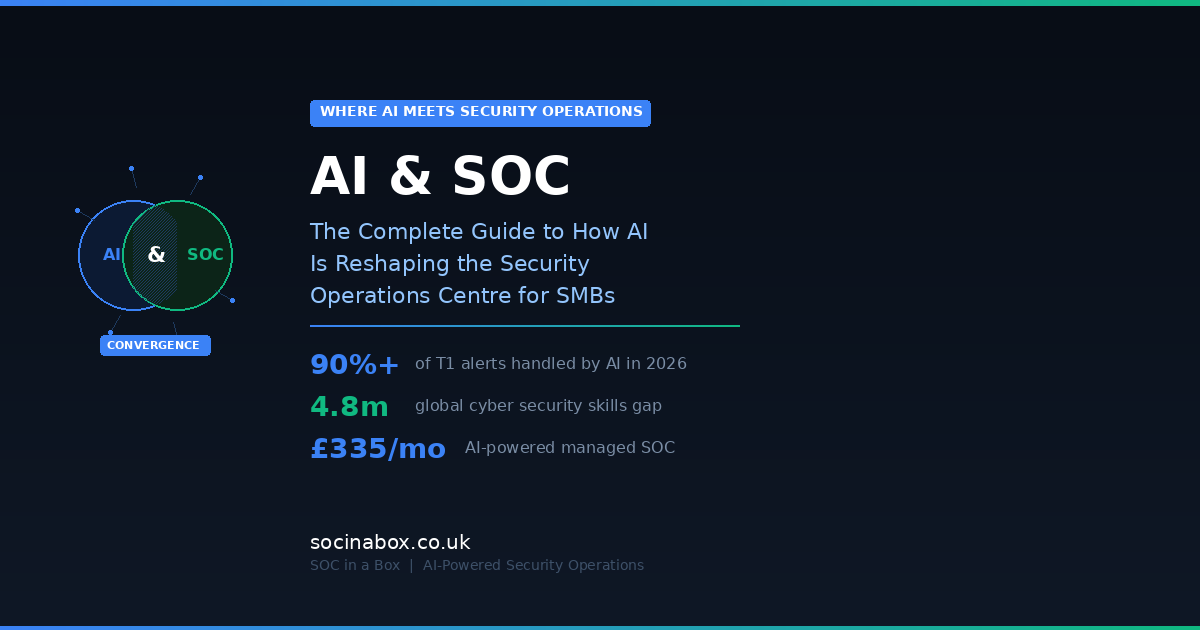
For large enterprises, this convergence means their existing SOC teams can handle exponentially more threats with greater speed and accuracy. For small businesses, it means something even more significant: the SOC model itself, once exclusive to organisations with six-figure security budgets, is now accessible at a price point and complexity level that works for a business with twenty, fifty, or a hundred employees.
This article is the complete guide to AI & SOC in 2026. It explains how the traditional SOC model works, why it has historically excluded small businesses, how AI is transforming every layer of security operations, what the modern AI-augmented SOC looks like in practice, and how your business can adopt it without needing a dedicated security team.
The Traditional SOC: Powerful but Inaccessible
A Security Operations Centre is the centralised function responsible for monitoring an organisation's IT environment, detecting cyber threats, investigating security incidents, and coordinating the response. If you are unfamiliar with the concept, our foundational guide to what a SOC is and why your business needs one explains the basics in plain English.
In its traditional form, a SOC consists of three core elements: technology (SIEM platforms, EDR tools, firewalls, threat intelligence feeds, and ticketing systems that collect and surface security data), people (tiered teams of analysts — Tier 1 for alert triage, Tier 2 for deeper investigation, Tier 3 for advanced threat hunting and incident response), and processes (documented playbooks, escalation procedures, communication protocols, and compliance workflows that govern how threats are handled).
This model works. It is how the world's largest organisations have protected themselves for the past two decades. But it has a fundamental problem: cost. Running a traditional SOC requires a minimum of four to five analysts for genuine 24/7 coverage, at a staffing cost of £200,000 to £350,000 per year in the UK — before you add SIEM licences (£30,000 to £100,000+), EDR tools, threat intelligence subscriptions, and the management overhead of running a shift-based operation. The total annual cost comfortably exceeds £300,000 for even a modest SOC.
For enterprises with thousands of employees and millions in revenue, this is a manageable investment. For a small business with 30 employees and tight margins, it is fantasy. The result has been a two-tier security landscape: large organisations with genuine detection and response capability, and small businesses with tools installed but no one meaningfully watching the output. The convergence of AI & SOC is dismantling that barrier.
Why the Traditional SOC Model Is Breaking Down
Even for organisations that can afford a traditional SOC, the model is straining under pressures that have intensified dramatically in 2025 and 2026.
Alert Volume Has Overwhelmed Human Capacity
The proliferation of security tools has created an alert firehose. A mid-sized organisation with EDR, SIEM, cloud security, email filtering, and identity monitoring can generate tens of thousands of alerts per day. Industry analysis consistently finds that only 1–5% of these alerts represent genuine threats — the rest are false positives, low-priority noise, or duplicate notifications from overlapping tools. But each alert must be investigated to make that determination, and human analysts simply cannot keep pace.
The consequence is alert fatigue: analysts triage by gut feel rather than thorough investigation, take shortcuts, and inevitably miss genuine threats buried in the noise. The SANS 2026 Cybersecurity Workforce Report found that 27% of organisations have experienced breaches directly attributable to workforce capability gaps — gaps that manifest most clearly in the inability to investigate alerts quickly and consistently enough.
The Skills Crisis Shows No Sign of Easing
The global cyber security workforce gap stands at approximately 4.8 million unfilled positions. In the UK, an estimated 637,000 businesses lack basic cyber security skills. The SANS 2026 report marked a decisive shift: for the first time, skills gaps overtook headcount shortages as the industry's top workforce challenge, with 60% of organisations identifying capability deficits as a greater problem than staffing levels.
For SOCs specifically, the impact is acute. Entry-level Tier 1 analyst roles — the positions most critical for alert triage volume — have seen a 32% reduction as organisations struggle to fill them and as AI absorbs the routine work. Meanwhile, the specialist skills needed for threat hunting, incident response, and AI governance are in even shorter supply, with demand for new AI security roles nearly doubling year-over-year.
Attackers Have Already Adopted AI
Adversaries are not waiting for defenders to catch up. AI-generated phishing emails bypass traditional content filters because each message is unique and contextually relevant. Automated vulnerability scanning identifies targets at industrial scale. Polymorphic malware changes its signature with every deployment, evading signature-based detection. Ransomware-as-a-Service combined with AI automation has made it profitable for criminals to target businesses that were previously too small to be worth the effort. Our ransomware guide for small UK businesses documents how these AI-enhanced attacks specifically target SMBs and the devastating impact they have.
The equation is straightforward: if attackers are using AI to scale their offence, defenders must use AI to scale their defence. A SOC operating at human speed against AI-powered attacks is fighting with a structural disadvantage.
How AI Is Transforming Every Layer of the SOC
The convergence of AI & SOC is not a single technology bolted onto an existing process. It is a transformation that touches every layer of security operations — from how data is ingested to how incidents are resolved. Here is what that transformation looks like in practice.
Layer 1: Intelligent Data Ingestion and Normalisation
Before any analysis can happen, data from diverse security tools must be collected, normalised into a common format, and enriched with contextual information. Traditional SIEMs handle this through pre-built parsers and manual configuration — a process that is time-consuming, brittle, and requires constant maintenance as tools are updated or replaced.
AI transforms this layer by automatically recognising data formats, normalising events without manual parser development, and enriching raw telemetry with contextual metadata — user identity, device ownership, geographic location, historical baseline behaviour, and threat intelligence matches. This intelligent ingestion means the SOC can onboard new data sources faster, maintain broader visibility, and ensure that downstream analysis operates on rich, consistent data rather than fragmented, inconsistently formatted logs.
Layer 2: AI-Powered Alert Triage
This is the layer where AI & SOC convergence delivers its most immediate and measurable impact. Traditional Tier 1 triage — a human analyst reading each alert, querying relevant systems, and deciding whether to escalate or close — is being replaced by AI systems that perform the same function at machine speed.
Industry predictions confirmed by production deployments in 2026 indicate that AI now autonomously resolves over 90% of Tier 1 alerts. It classifies each alert based on type and severity, enriches it with relevant context, investigates by querying connected tools, and delivers a verdict — all in minutes rather than the 20–60 minutes a human analyst would require.
Our own EmilyAI engine, eight years in production, eliminates 92% of alert noise through contextual AI triage. It does not simply filter by static rules — it understands that a login from an unusual location means something different for a business with travelling sales staff than for a business where everyone works from the same office. This contextual intelligence is what separates genuine AI triage from basic automation. Our article on how EmilyAI works provides the full technical detail.
Layer 3: Autonomous Investigation
Beyond triage, AI is now conducting full investigations autonomously. When an alert warrants deeper analysis, agentic AI systems — built on large language models with tool-use capabilities — plan and execute multi-step investigations without human intervention. They query EDR for process execution history, check identity providers for authentication anomalies, search email gateways for related phishing activity, correlate network traffic with threat intelligence, and synthesise findings into a coherent investigation report.
This agentic capability is fundamentally different from the playbook-driven automation of SOAR platforms. SOAR follows pre-written scripts: "if alert type X, run steps 1-2-3." Agentic AI reasons: "given this alert and the available evidence, what is the most effective investigation approach?" It adapts as new evidence emerges, tries alternative hypotheses when initial lines of enquiry are inconclusive, and produces investigations of a depth and consistency that match or exceed what a skilled human analyst would deliver.
Layer 4: Proactive Threat Hunting
Traditional SOCs dedicate their most experienced analysts — typically Tier 3 — to threat hunting: proactively searching for threats that have evaded all detection mechanisms. This is the highest-value analytical work in security operations, but in a human-only SOC, it is perpetually squeezed by the operational demands of alert triage and incident response. Analysts who should be hunting are instead fighting fires.
In the AI & SOC model, AI handles the operational throughput of triage and investigation, freeing human expertise for proactive hunting. But AI also augments the hunting itself — continuously scanning historical and real-time data for indicators of compromise, mapping observed activity against the MITRE ATT&CK framework, and identifying patterns that match known adversary techniques but have not triggered any conventional alert.
Layer 5: Automated and Assisted Response
Detection without response is expensive observation. The AI & SOC convergence extends into the response layer, where AI can execute containment actions either autonomously or with one-click human approval: isolating compromised endpoints, blocking malicious network traffic, disabling compromised accounts, quarantining emails organisation-wide, and triggering incident response workflows.
The speed advantage is decisive. The time between an attacker gaining initial access and beginning lateral movement is measured in hours. Every minute saved in detection-to-response reduces the blast radius. AI-powered response measured in minutes replaces human-coordinated response measured in hours — and for small businesses without on-call security staff, replaces what would otherwise be response measured in days or weeks.
Layer 6: Deception and Active Defence
One of the most innovative applications of the AI & SOC model is deception technology — deploying honeypots, decoy files, and simulated services that look like legitimate targets to an attacker but serve no business purpose. Any interaction with a decoy is, by definition, suspicious. This gives the AI a zero-false-positive signal that complements probabilistic analysis from other detection layers.
SOC in a Box includes DecoyPulse as standard — deception sensors deployed across your network that are invisible to legitimate users but irresistible to attackers conducting reconnaissance. When something touches a decoy, the AI has immediate, high-confidence evidence that drives rapid investigation and containment.
Layer 7: Continuous Intelligence and Learning
The final layer of the AI & SOC model is a feedback loop. Every investigation, every verdict, every confirmed threat and every confirmed false positive feeds back into the AI's models. Threat intelligence from dark web monitoring, industry feeds, and government sources is continuously integrated. The system becomes more accurate over time, increasingly tuned to the specific patterns, risks, and legitimate behaviours of your particular environment.
This continuous learning is what makes AI-powered security operations fundamentally different from static tools. Your antivirus does the same thing today that it did last month. An AI-augmented SOC is measurably better this month than it was last month, because it has learned from every event it has processed in the interim.
What the Modern AI-Augmented SOC Looks Like for an SMB
For a small business engaging a managed AI & SOC service, the practical experience is remarkably simple compared to the technical sophistication operating behind the scenes.
A physical or virtual appliance connects to your network. With SOC in a Box, a purpose-built appliance arrives within one working day. It connects to your network and begins ingesting telemetry from your endpoints, cloud services, email platform, and network infrastructure. Full deployment takes five working days from order to live 24/7 monitoring — the deployment page walks through the process step by step.
AI begins processing immediately. EmilyAI starts triaging alerts from day one, building behavioural baselines for your users and devices, and correlating your internal telemetry with global threat intelligence. During the initial tuning period, the system learns what normal looks like in your specific environment — reducing false positives and increasing detection accuracy week by week.
A named human analyst provides oversight and expertise. Your named, CREST-certified analyst is not a faceless ticket queue. They learn your network, your users, your business context, and your escalation preferences. They review every AI-escalated alert, handle complex investigations that require human judgment, provide strategic security guidance, and serve as your single point of contact for all security matters.
You receive clear, actionable reporting. Monthly reports summarise threats detected and resolved, your overall security posture via the Confidence Score, recommendations for improvement, and any trends or intelligence relevant to your sector. This reporting is designed for business leaders, not security engineers — your board can understand it without a technical briefing.
You pay a single monthly invoice. No separate bills for SIEM, EDR, threat intelligence, dark web monitoring, vulnerability scanning, Cyber Essentials certification, or cyber liability insurance. The AI & SOC model delivers all of these through a unified service that replaces the collection of disconnected security tools most SMBs are currently paying for — typically at a lower total cost. Our analysis of piecemeal security costs shows that the average SMB with 40 endpoints spends over £18,000 per year on fragmented security tools that do not talk to each other.
AI & SOC: The Human Role in 2026
The convergence of AI & SOC inevitably raises the question: does AI replace human security professionals? The answer from every credible source in 2026 is the same — no, but it fundamentally transforms what humans do.
The SANS 2026 Workforce Report documented the shift clearly. Entry-level Tier 1 analyst roles have decreased by 32% as AI absorbs routine triage. But simultaneously, 34% of organisations have created AI/ML security specialist roles, 32% have added AI security engineering positions, and 30% have established AI governance analyst roles. The net effect is not fewer jobs but different jobs — jobs that are more strategic, more intellectually demanding, and more valuable to the organisation.
In the AI & SOC model, the human analyst shifts from execution to oversight. They become the person who handles the cases that AI escalates as genuinely complex or ambiguous. They hunt proactively for threats that have evaded automated detection. They provide the business context that AI cannot infer from telemetry — understanding that the CEO's unusual login is because they are travelling, not because their account is compromised. They communicate with leadership during incidents, make response decisions that have legal or regulatory implications, and guide the strategic evolution of the organisation's security posture.
For small businesses accessing this model through a managed service, the implication is that the human experts behind the service are liberated from mechanical triage work and can devote their attention to what actually matters — genuine threats, strategic guidance, and the nuanced judgment that keeps your business safe.
Compliance, Governance, and Trust
Deploying AI within security operations creates legitimate questions about compliance and governance that responsible organisations should address.
UK GDPR. An AI & SOC system processes personal data — authentication logs, email metadata, user activity records. Appropriate data processing agreements, lawful bases for processing, and data residency arrangements must be in place. For UK businesses, data should be processed and stored within the UK or the EU.
Auditability. Every AI investigation must produce a transparent, auditable trail. Regulators, insurers, and clients may ask how your security monitoring works and what decisions are being made automatically. Black-box AI that cannot explain its reasoning is a compliance liability. The best AI & SOC platforms produce detailed investigation reports showing every tool queried, every piece of evidence gathered, and the full reasoning chain behind every verdict.
AI governance. The push toward ISO 42001 certification for AI governance reflects growing recognition that autonomous AI systems in security-critical contexts need structured oversight frameworks. While not yet mandatory, organisations should ensure their provider follows governance best practices and can demonstrate responsible AI deployment.
Cyber Essentials alignment. For UK small businesses, Cyber Essentials Certification establishes the baseline preventive controls. An AI & SOC service provides the detection and response layer that Cyber Essentials does not cover. Together, they deliver a proportionate, auditable security framework that satisfies regulatory expectations and supply chain requirements alike.
The Economics: Why AI & SOC Makes Financial Sense for SMBs
For small business owners, the question is ultimately economic. Here is how the numbers work.
What most SMBs currently spend. A typical 40-person professional services firm in the UK pays for standalone antivirus, a managed firewall, annual penetration testing, vulnerability scanning, dark web monitoring, and Cyber Essentials certification — all from different vendors, none of them integrated. Based on our 2025 pricing survey of South East England businesses, the average annual spend on this piecemeal approach is approximately £18,160.
What an AI & SOC service costs. SOC in a Box — which replaces or surpasses every one of those line items with a single, integrated, AI-powered, analyst-backed service — costs from £335 per month for a small business. For a 50-asset firm, the annual cost is approximately £7,200. That is a net saving of roughly £10,960 per year — while getting dramatically better protection. The savings calculator provides a personalised comparison for your specific business in sixty seconds.
What a breach costs. The average remediation cost for a UK business suffering a cyber attack is approximately £21,000. Ransomware demands average £115,000. ICO fines under GDPR can reach 4% of annual turnover. And 60% of small businesses that suffer a major breach close within six months. Against these figures, the investment in an AI & SOC service is not an expense — it is one of the most cost-effective risk mitigation measures available.
What you gain beyond security. Certification, compliance evidence, a demonstrable security posture for clients and partners, reduced cyber insurance premiums, and the competitive advantage of being provably protected in a market where buyers increasingly require it. The full breakdown of breach costs for small UK businesses quantifies exactly what is at stake.
Getting Started with AI & SOC
Adopting the AI & SOC model does not require a security background or a transformation programme. Here is the practical path for a small business.
Establish your baseline. Ensure the five fundamental security controls are in place: firewalls configured, software updated, user access controlled, malware protection active, and MFA enabled on all cloud services. Cyber Essentials Certification — from £320 — formalises and verifies this baseline. Our backup and MFA guide covers the two highest-impact quick wins.
Audit your current spend. List every security-related invoice you currently pay: antivirus, firewall management, pen testing, vulnerability scanning, dark web monitoring, Cyber Essentials, cyber insurance. Totalise the annual cost. This is the benchmark against which a managed AI & SOC service should be compared — and you may be surprised how much you are already spending on tools that do not talk to each other.
Book a scoping call. A good managed SOC provider will map your current environment, identify what telemetry is available, explain what monitoring would look like for your specific setup, name your analyst, and provide a firm price — with no obligation. SOC in a Box moves from scoping call to live 24/7 monitoring in five working days.
Go live and tune. The first few weeks involve tuning — the AI and your named analyst learn the patterns of normal activity in your environment. Expect to provide some context during this period about expected behaviours, approved applications, and known exceptions. After tuning, the service settles into steady-state operation: continuous AI-powered monitoring, proactive threat hunting, and human analyst oversight, all delivered through a single monthly invoice.
Conclusion: The SOC Is No Longer Out of Reach
The convergence of AI & SOC has eliminated the single biggest barrier that prevented small businesses from accessing genuine security operations: cost. The technology that was previously available only to enterprises with dedicated analyst teams and six-figure budgets is now accessible through managed services that cost less than most SMBs already spend on fragmented, disconnected security tools.
AI handles the operational throughput — triaging every alert, investigating every incident, correlating evidence across your entire environment, and responding to threats in minutes. Human experts handle what AI cannot — complex judgment, business context, strategic guidance, and the nuanced decisions that keep your organisation safe and compliant.
In 2026, with 43% of UK businesses experiencing cyber attacks annually, with the NCSC making clear that attacks are a question of when rather than if, and with AI-powered threats making traditional defences increasingly unreliable, the question is no longer whether small businesses need a SOC. It is whether they can afford not to have one.
The answer, thanks to AI & SOC, is that they can no longer afford not to — because the cost of protection has finally fallen below the cost of risk.
AI-Powered SOC for Your Business
SOC in a Box replaces seven security invoices with one. EmilyAI, DecoyPulse, dark web monitoring, a named CREST-certified analyst, and Cyber Essentials — all included. From £335/month. Typical saving: £10,960/year.
See plans and pricing