On 13 April 2026, Basic-Fit — Europe's largest budget gym chain with more than 2,150 clubs across 12 countries — confirmed that hackers had gained unauthorised access to its member visit-registration system and exfiltrated data belonging to approximately one million customers. The stolen records include full names, home addresses, email addresses, phone numbers, dates of birth, and bank account details. Members in the Netherlands, Belgium, Luxembourg, France, Spain, and Germany were all affected.
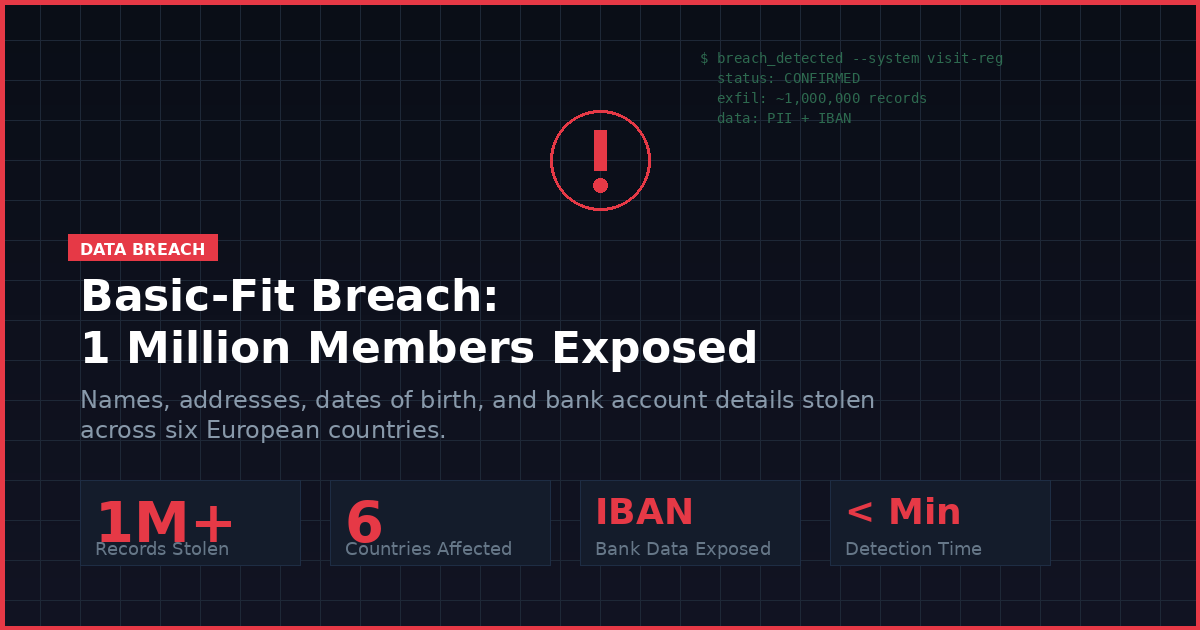
Basic-Fit says it detected the intrusion through its internal monitoring tools and shut the attacker out within minutes. Despite that rapid response, a significant volume of personal and financial data had already been extracted. The company has notified the Dutch Data Protection Authority (Autoriteit Persoonsgegevens) and directly informed every affected member.
This is not just a story about a large European fitness company. It is a case study in what happens when customer data — the kind every small business holds — ends up in the wrong hands. If you run a gym, a salon, a subscription box, a membership club, or any business that stores customer payment details, this breach has direct lessons for you.
What Was Stolen and Why It Matters
The attackers accessed a system that recorded member visits to Basic-Fit clubs. That single system held names, addresses, contact details, dates of birth, and bank account information. No passwords or identity documents were taken — Basic-Fit confirmed it does not store copies of passports or driving licences — but the combination of personal details and banking data is more than enough for criminals to mount convincing phishing campaigns, attempt social engineering attacks, or commit direct debit fraud.
For small business owners, the important question is not whether your business is as large as Basic-Fit. It is whether you hold the same types of data. If you collect customer names, email addresses, phone numbers, and payment details — and most subscription-based businesses do — then you hold exactly the kind of information that attackers target. The only difference is scale.
Lessons for UK Small Businesses
1. Know What Data You Hold and Where It Lives
Basic-Fit's breach came through its visit-registration system — not its main website, not its app, but a back-end system that logged when members entered a club. Many small businesses have similar secondary systems: a booking platform, a CRM, a mailing list tool, or a spreadsheet of customer details stored on a shared drive. Every one of these is a potential target. You cannot protect what you do not know you have. Conduct a simple data audit: list every system that holds customer information, what data it contains, and who has access to it.
2. Minimise What You Store
Basic-Fit's decision not to store identity documents meant that passports and driving licences were not compromised. That is data minimisation working exactly as intended. Ask yourself: do you genuinely need to keep bank account details on file, or could you use a payment processor like Stripe or GoCardless that handles the sensitive data for you? Under both UK GDPR and EU GDPR, you are required to collect only the personal data that is necessary for the purpose you have stated. Less data stored means less data stolen.
3. Monitoring and Detection Save You
Basic-Fit's monitoring tools detected the intrusion and enabled their team to shut it down within minutes. Without that monitoring, the breach could have continued for days or weeks — as has happened in many other incidents. Small businesses often assume that security monitoring is expensive and complex, but affordable tools exist. Our managed security services provide exactly this kind of detection capability, scaled for smaller organisations.
4. Have a Breach Response Plan Before You Need One
Basic-Fit notified its data protection authority, informed affected members, and engaged external security specialists — all on the same day. That speed of response does not happen by accident. It happens because you have a plan written, tested, and ready. Every UK business that processes personal data should have an incident response plan that covers who to contact, what to communicate, and how to contain the damage.
5. Third-Party Systems Are Your Risk Too
The breached system at Basic-Fit was specifically the club visit-registration platform. If you use third-party software to manage bookings, memberships, or payments, those systems hold your customers' data — and their security is your responsibility in the eyes of the Information Commissioner's Office (ICO). Check that your suppliers have current security certifications, ask about their incident response procedures, and ensure your contracts include data protection obligations.
The Phishing Risk Is Immediate
Basic-Fit has warned affected members that the primary risk is phishing. Criminals who now have a million people's names, email addresses, phone numbers, dates of birth, and bank details can craft extraordinarily convincing fake emails and text messages. They can impersonate Basic-Fit, the member's bank, or a government agency — and they can include enough genuine personal detail to fool even cautious recipients.
This is why data breaches matter to every business, not just the one that was breached. If your customers are also Basic-Fit members, they may receive phishing messages that reference their gym membership. They may become more suspicious of all digital communications — including your legitimate ones. Helping your customers understand phishing, and ensuring your own communications are clearly authentic, is part of your duty of care.
What You Should Do This Week
- Audit your customer data. List every system, spreadsheet, and service that holds personal information. Identify anything you no longer need and delete it.
- Review your payment handling. If you store bank details or card numbers directly, investigate whether a payment processor could hold that data instead.
- Check your suppliers. Contact the providers of any software that holds your customer data and ask about their security measures.
- Write or update your breach response plan. Even a simple one-page document is better than nothing.
- Brief your team. Make sure every employee knows not to click suspicious links and knows who to contact if something looks wrong.
A data breach does not have to be your story. But the only way to ensure that is to act before it happens, not after.
Protect Your Business Before a Breach Happens
Our team helps small businesses across the UK secure their customer data, meet GDPR requirements, and build incident response plans that actually work. Find out how affordable proper protection can be.
View pricing plans